Contract Redlining
Redlining, in the sentences the lifecycle gives it
Redlining is how the negotiation stage of a contract lifecycle proceeds. IBM's description is compact: the parties negotiate terms through revisions and redlining the document to address concerns, edits and required changes to the terms and conditions. IBM adds that AI-assisted redline tracking can help manage the changes, flagging any deviations from standard contract terms. Two things follow. Redlining is a record of disagreement rather than a formatting exercise, and it is the mechanism by which terms change between a draft and an execution copy.
What goes wrong in a redlining round
How the agreed document moves after the markup
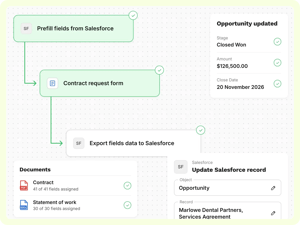
After the markup, altaFlow describes a four-move loop for the agreed document. These are altaFlow's platform claims, not part of the stage IBM describes.
1
Data leaves the record
altaFlow pulls from Salesforce or captures a web form.
2
One pass builds the document
Conditional logic and dynamic tables assemble the correct version.
3
A governed workflow routes it
Approval and signature, every step tracked.
4
The result writes back
Into the system of record, with no re-typing.
What altaFlow states it brings to a markup
Six capabilities from altaFlow's negotiation page, ordered here by where they bear on a markup round. These are altaFlow's own product claims.
Redlining and versions
altaFlow claims edits, comments and document versions tracked in one place, to eliminate email chains and the risk of working from outdated drafts. Working from a superseded draft is the failure a checklist exists to prevent.
Side-by-side comparison
altaFlow describes visualising changes between document versions to speed up contract review and management. This is the capability behind the fifth check above: comparing versions rather than reading an account of what changed.
Clause library
altaFlow describes a centralized clause library letting sales and procurement build contracts from pre-approved legal language, reducing reliance on legal teams for standard agreements. Knowing what counts as standard is what makes a deviation visible.
Dynamic clauses
altaFlow states clauses can be inserted or suggested automatically based on contract data such as jurisdiction or deal size. That handles the clauses a redline should never have needed to raise in the first place.
Role-based permissions
altaFlow states it controls who can view, edit or approve agreements. Applied to a redline, this is what prevents an edit whose authority nobody verified at the moment it was made.
One trail to signature
altaFlow claims the entire history, from draft to signature, is captured in one immutable audit trail. The redline and the execution copy then sit in the same record rather than in two.
A six-point checklist for a redlining round
Six checks, in this order. Each one closes a gap the sources name rather than a gap general advice imagines.
No parallel copies circulating by email.
Know which clauses are pre-approved before edits arrive.
Mark departures from standard terms as they appear.
Keep the concern next to the change it caused.
Read the versions side by side, not a summary.
Confirm who may approve each concession.
What IBM's sentence actually names
IBM's sentence on this stage names one mechanism and the three things it addresses. A markup that records only the first is a diff, not a negotiation record.
The mechanism IBM names for changing terms.
The objection a change was made to address.
The change as it now stands in the text.
Those a party treats as a condition.
Two records of documents kept in one version
Both accounts come from altaFlow's published customer records, and neither is a markup case; they are included for the version-control point they do record.
-
T2 Biosystems configured a no-code workflow to match their own process
-
Every end-user now interacts with the most current version of a form
-
Resulting in the elimination of version control issues, which is what the story page records, alongside save-and-return functionality, and its statement that the time savings were immediate without publishing any figure
-
Royal Care streamlined the HR processes on altaFlow's no-code platform
-
The flows span onboarding through incident reporting
-
Resulting in the elimination of dual entry, on the card's own account, on a card that spans HR workflows from onboarding through incident reporting and that publishes no figure of any kind alongside it
Who marks up a contract
Three teams appear in altaFlow's own descriptions of this work, wanting different things from the same markup. The third comes from its approvals page.
Legal teams drastically reduce time spent on low-value reviews, in altaFlow's stated framing.
Procurement teams standardize vendor agreements and streamline onboarding, in altaFlow's own words.
Sales teams accelerate deal approvals for pricing exceptions, custom terms and contract modifications, routed to managers, RevOps and legal.
Two named speakers on keeping one record
Ginzberg is the named speaker for Royal Care, whose card spans onboarding to incident reporting. As published before the rebrand: 'There is no need for dual entry; WorkFlow eliminated the risk of errors.'
Hoffman is a named speaker for T2 Biosystems, and her account is about what a single record does to audit burden: 'Compliance audits, which once took weeks, are now completed in just days.' The story page publishes no figure.
Four checks worth doing deliberately
Four checks that explain why the six above are in that order, each closing a gap the sources name explicitly rather than one general advice imagines.
Flag deviations during the exchange, not at signature
IBM notes AI-assisted redline tracking can help manage the changes and flag any deviations from standard contract terms. A deviation caught mid-exchange is a decision someone makes; the same deviation found at signature is a renegotiation, and unrecorded changes are one of the three named loss causes.
Keep the concern attached to the edit
IBM's sentence names concerns and required changes alongside the revisions themselves. A tracked change without the reason behind it tells a later reader what the text says but not what was conceded, which is the thing a renewal or a dispute will need.
Read the versions, not the summary
altaFlow describes side-by-side version comparison as visualising changes between document versions to speed up review. A change summary is a second-hand account written by someone with a view about which edits matter, applied to a counterparty's edits before signature.
Separate conditions from preferences early
IBM distinguishes concerns and edits from required changes in the same sentence. Treating all three as equivalent is what makes a redlining round long: the conditions are the negotiation, and the preferences are what gets traded to settle them.
Governance the marked-up document sits under
Audit trails
IBM notes automation can provide an audit trail
Retention limits
GDPR sets a storage limitation principle
HIPAA Security Rule
Administrative, physical and technical safeguards for ePHI
SOC 2
An AICPA examination of a service organization's controls
Processing scope
GDPR covers automated and manual processing alike
Card-data handling
altaFlow routes transactions through third-party PCI DSS processors
What altaFlow states it brings to a markup
Six capabilities from altaFlow's negotiation page, ordered here by where they bear on a markup round. These are altaFlow's own product claims.FAQs about contract redlining
Six questions that come up when a team tries to make a markup round produce a usable record.Optimize your document workflows
From quick wins on day one to measurable impact in under 90 days.