How to Choose Contract Management Software

What the choice actually turns on
The right feature set depends on contract volume and complexity, in IBM's framing, but most modern platforms include a common core of capabilities. That makes the decision less about which product has a feature and more about which has it at the depth a portfolio needs. IBM is explicit about where the differences hide: when evaluating vendors, confirm which of these features come standard and which require add-ons, because pricing and depth vary widely across the market. The criteria below follow from that instruction.
What an evaluation can miss
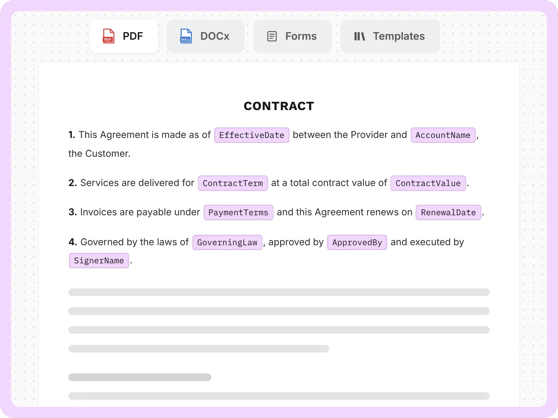
What altaFlow states its own loop does
For reference only, altaFlow describes its document loop in four moves. These are altaFlow's platform claims, and this page makes no assessment of them.
1
Data leaves the record
altaFlow pulls from Salesforce or captures a web form.
2
One pass builds the document
Conditional logic and dynamic tables assemble the correct version.
3
A governed workflow routes it
Approval and signature, every step tracked.
4
The result writes back
Into the system of record, with no re-typing.
Six of the capabilities IBM names as critical
IBM names a set of capabilities most modern platforms include. Six are below; a seventh, reporting and analytics dashboards, is covered in the questions at the end.
Central repository
IBM's first item is a single, searchable location for every contract and its associated documents. Check what counts as searchable: the contract body and attachments, or only metadata someone remembered to fill in.
Clause libraries
IBM pairs AI-assisted drafting with pre-approved language that speeds up authoring and keeps terms consistent. Check who can change the library: one only legal can edit goes stale, one anyone can edit stops being pre-approved.
Approval workflows
IBM describes rules that route contracts to the right approvers based on value, risk or contract type. Check whether an operations team can change those rules without a developer, since routing changes far more often than the contract templates do.
Renewal and obligation alerts
IBM lists automated alerts and notifications that flag upcoming deadlines before they get missed. Check what the alert is attached to: a date field someone types, or an obligation the system extracted from the signed document.
E-signature
IBM's item is a built-in way to run contracts without switching tools. Check whether it is genuinely built in or a bundled third-party product, because that determines where the audit trail breaks and who holds the signed original.
Risk and compliance monitoring
IBM describes ongoing checks that flag clauses or terms falling outside policy. Check whether the monitoring runs after signature as well as before, since IBM's own compliance stage is a post-signature one.
Six steps through an evaluation
Six steps, in this order. The order matters because the first two determine which capabilities you are entitled to weight heavily.
IBM ties the right feature set to contract volume and complexity.
Write down the sequence your contracts actually follow.
Legal, procurement, sales and finance, per IBM.
Rate each capability on depth, not presence.
IBM's own instruction, and the easiest one to skip.
IBM names ERP, CRM and procurement systems.
Four questions to put to every vendor
The first two questions come straight from IBM's evaluation instruction. The other two do not, and are offered as this page's own, because a demo will not answer them unprompted.
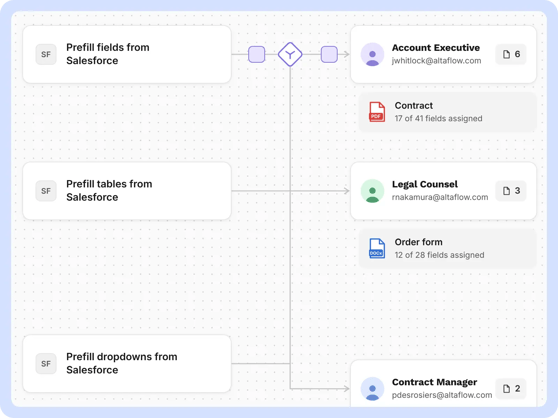
Which of these features come standard, per IBM.
How deep each capability goes, not whether it exists.
Whether the business can reconfigure routing unaided.
What the audit trail captures, and at which stages.
Two records of a document process brought under control
Both accounts come from altaFlow's published customer records and stay inside what those records state.
-
T2 Biosystems configured a no-code workflow to match their own process
-
Completed compliant documents attach back to Salesforce records
-
Resulting in save-and-return functionality for end users and, per Hoffman's testimonial, compliance audits moving from weeks to days, while the story page itself states the time savings were immediate without publishing any figure
-
Non-technical staff built and deployed the workflows themselves after minimal training
-
Roughly 20,000 workflow transactions now run per year
-
Resulting in a billing team of three handling the volume the story says would otherwise have required nine, with the company quadrupling in size and no headcount added to billing operations, and fewer than two support contacts needed across three years of use
Who should be in the evaluation
IBM names four teams that typically manage the process and says they all work from the same version of a contract. altaFlow's own pages describe three of them.
Legal teams standardize contract creation, reduce risk, and maintain a centralized, auditable repository.
Procurement teams streamline vendor onboarding, automate purchase agreements and manage contract renewals proactively.
Sales teams accelerate deal approvals for pricing exceptions, custom terms and contract modifications.
The practitioners named in altaFlow's own records
Rader is the named speaker for Prosegur Security USA: 'I could show you how to build a workflow in about five minutes. I very rarely even have to go to the help documents.' The story records non-technical staff building their own workflows after minimal training.
Hoffman is a named speaker for T2 Biosystems: 'Compliance audits, which once took weeks, are now completed in just days.' Her account bears on the post-signature half of an evaluation rather than on the drafting half.
Four practices that separate a real evaluation from a demo tour
Four practices, each addressing a way an evaluation reaches the wrong answer while feeling thorough.
Score depth rather than presence
IBM says most modern platforms include a common core of capabilities, so a feature checklist risks coming back almost entirely ticked for every vendor. The discriminating question is how far each capability goes, which is why IBM pairs its list with an instruction about depth and packaging.
Ask which capabilities are add-ons before the shortlist
IBM's instruction is to confirm which of these features come standard and which require add-ons, because pricing and depth vary widely across the market. Asked after a shortlist is drawn, the answer changes the comparison but not the shortlist, which is the wrong way round.
Evaluate the post-signature half as seriously as the drafting half
IBM places compliance and risk monitoring and renewal after signing, and the WorldCC figure it cites is a post-signature loss of an average 11 percent of contract value. Evaluations weighted towards authoring are weighted away from where the value leaks.
Test whether the business can reconfigure the routing
IBM describes approval rules routing by value, risk or contract type. Whether an operations team can change those rules unaided decides how the system ages, because routing changes more often than templates and every change otherwise becomes a request to somebody else.
Governance obligations these systems sit under
Audit trails
IBM notes automation can provide an audit trail
Retention limits
GDPR sets a storage limitation principle
HIPAA Security Rule
Administrative, physical and technical safeguards for ePHI
SOC 2
An AICPA examination of a service organization's controls
Processing scope
GDPR covers automated and manual processing alike
Card-data handling
altaFlow routes transactions through third-party PCI DSS processors
Six of the capabilities IBM names as critical
IBM names a set of capabilities most modern platforms include. Six are below; a seventh, reporting and analytics dashboards, is covered in the questions at the end.FAQs about choosing contract management software
Six questions that decide an evaluation, including the one capability the cards above left for this block.Optimize your document workflows
From quick wins on day one to measurable impact in under 90 days.