Workflow Automation Examples
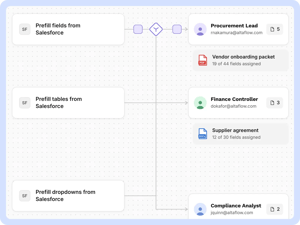
What counts as a workflow automation example
Workflow automation optimizes processes by replacing manual tasks with software that executes all or part of a process, in IBM's definition, today usually through software with low-code, drag-and-drop features. IBM distinguishes two types: business process workflows and robotic process workflows. That distinction decides what belongs on a list like this one. An example is a real process with documents moving through it and people waiting on decisions, not a feature. The examples below are drawn from the process categories the subject matter records and from altaFlow's own published customer stories.
Six document-heavy processes that get automated
Six process categories recur across document-heavy operations. Each one is a sequence where the documents and the approvals are the process rather than a by-product.
Quote to cash
The sales-side arc from configuring a quote through contract, order, invoicing and payment collection. The documents are quotes, order forms, sales contracts and invoices, with approval steps at pricing and at contract sign-off.
Loan processing
Banks evaluate applicants for credit risk by collecting information and documents from applicants, employers and credit rating agencies. IBM presents managing that flow and reducing documentation errors as a classic automation use case.
KYC and onboarding
Identity and compliance checks at customer intake: collecting IDs and verification documents, screening, and approval routing before an account opens. IBM lists account opening, inquiry processing and anti-money-laundering tasks among automated banking work.
Policy underwriting
Insurance underwriting and the flows beside it, claims processing, regulatory compliance and policy management, are repetitive and document-driven, which is the reason IBM gives for their being commonly automated in the industry.
Vendor onboarding
Bringing a new supplier into procurement systems: collecting tax and banking forms, compliance attestations and contracts, with approval steps before the first purchase orders. IBM's adjacent documented cases include purchase orders and accounts payable, and contract management.
HR onboarding
New-employee intake covering welcome communications, software access setup, orientation scheduling and paperwork processing. IBM notes that automating onboarding reduces the administrative burden carried by HR departments.
Six automations altaFlow names on its own pages
Four come from altaFlow's own use-case pages and two from customer stories: the first four are capabilities it names, the last two processes it records.
Vendor onboarding approvals
Named on altaFlow's approvals use-case page.
Invoice approval workflows
Amount-threshold routing with ERP and CRM status sync.
Contract approval workflows
Sales manager, legal counsel and executive sign-off, parallel or sequential.
Student onboarding
Applications, registrations and document requests.
Work order automation
Nationwide Roofing's card records automated work orders.
Order form generation
BillingTree's card records generated order forms.
Four of the outcome cards altaFlow publishes
altaFlow publishes outcome cards on its workflow-automation page. Four are below; a fifth, on cycle time, carries the only figure and is hedged.
Fewer manual errors
altaFlow's card states that automating data entry and validation ensures accuracy across every system, reducing costly rework. This is the platform's own framing of the outcome rather than an audited result.
Scale without headcount
The second card is about handling higher volumes of work without overwhelming the team, letting automation manage the throughput. Prosegur Security USA's story covers the same theme, though altaFlow does not pair them.
Process visibility
altaFlow claims real-time insight into the status of any workflow, identifying bottlenecks and supporting data-driven decisions about workflow optimization. Its own account of the problem is documents sitting in inboxes with no visibility.
Generation in the flow
The fourth card covers generating contracts, invoices or onboarding packets prefilled from a CRM or ERP, collecting information with web forms and capturing legally binding eSignatures.
What these examples replace
- Compliance exposure grows, on altaFlow's own account, where approval decisions happen in Slack threads or verbal conversations with no retrievable record.
- The same account names tool sprawl: approval requests in email, approvals in Slack, signatures in DocuSign, records in the ERP, each requiring manual reconciliation.
- Approval cycles stretch from hours to days, altaFlow states, because documents sit in inboxes with no visibility and no service-level enforcement behind them.
- IT becomes a bottleneck of its own, since altaFlow notes that every time a routing rule changes, someone has to file a ticket and wait.
Four things the stronger examples have in common
Four patterns run through the examples above. Three of them are visible in a published customer story; the first rests on IBM's definitions alone.
Automate the routing before the judgement
IBM's definition covers software executing all or part of a process, and its account of robotic process automation is confined to routine, repetitive tasks that mimic human interactions with applications. Handoffs, reminders and data transfer qualify; deciding whether an exception is acceptable does not.
Let the people who own the process build it
Prosegur Security USA's story records non-technical staff building and deploying their own workflows after minimal training. altaFlow states that in many cases a simple workflow can be built in about thirty minutes, with more complex ones taking several hours.
Close the loop back into the system of record
T2 Biosystems' story describes completed compliant documents attaching to Salesforce records in a closed loop. The story records that outcome and states the time savings were immediate without publishing a figure.
Pick a process where the document is the bottleneck
Every category above turns on a document waiting for a decision rather than on a calculation. NewSchool of Architecture & Design's story records disconnected document management and student information systems creating data silos.
Which teams these examples belong to
The examples cluster by function rather than by industry. These are the roles altaFlow's own use-case pages name.
- Operations leaders streamline vendor onboarding and internal change requests, and gain control over cross-departmental processes.
- IT and platform owners reduce custom development requests and provide a governed, secure platform.
- Finance automates purchase order approvals, expense reimbursements and invoice processing; procurement handles vendor onboarding, purchase agreements and renewals.
Those pages describe what each group automates with altaFlow rather than ranking the examples on this page.
The practitioners named in two of these examples
Jeffrey Rader Information Technology Director
Rader is the named speaker for Prosegur Security USA, and his account is about who ended up building the workflows: 'It is a very, very intuitive product. I could show you how to build a workflow in about five minutes.'
Mandy Hoffman Business Operations Manager
Hoffman is a named speaker for T2 Biosystems, and her account is about the audit consequence rather than the build: 'Compliance audits, which once took weeks, are now completed in just days.'
Two examples in full, as published
Both accounts come from altaFlow's published customer stories and stay inside what those stories record.
Billing operations at Prosegur Security USA
Prosegur Security USA automated billing document workflows as the business grew, across a United States workforce the story puts at roughly 7,000 people
Non-technical staff built and deployed the workflows themselves
Roughly 20,000 workflow transactions now run per year
Resulting in a billing team of three handling the volume the story says would otherwise have required nine, with the company quadrupling in size and no headcount added to billing operations, and fewer than two support contacts needed across three years of use
Compliant forms at T2 Biosystems
T2 Biosystems ran workflows on MS Word and Adobe Acrobat, where end-users could not save a partly completed form and return to it later
T2 Biosystems configured a no-code workflow to match their own process
Completed compliant documents attach back to Salesforce records
Resulting in save-and-return functionality for end users and, per Hoffman's testimonial, compliance audits moving from weeks to days, while the story page itself states the time savings were immediate without publishing any figure
Governance obligations these examples sit under
- Audit trails: IBM notes automation can provide an audit trail
- Retention limits: GDPR sets a storage limitation principle
- HIPAA Security Rule: Administrative, physical and technical safeguards for ePHI
- SOC 2: An AICPA examination of a service organization's controls
- Processing scope: GDPR covers automated and manual processing alike
- Card-data handling: altaFlow routes transactions through third-party PCI DSS processors
The shape every one of these examples takes on altaFlow
Underneath the variety, altaFlow describes one loop in four moves. These are altaFlow's platform claims, not properties of workflow automation generally.
altaFlow pulls from Salesforce or captures a web form.
Conditional logic and dynamic tables assemble the correct version.
Approval and signature, every step tracked.
Into the system of record, with no re-typing.
FAQs about workflow automation examples
Six questions that come up when a team is trying to pick which of these to attempt first.
What separates a workflow automation use case from a feature?
The presence of a process. IBM's definition is software executing all or part of a process, replacing manual tasks. A feature does one thing on demand; a use case has a start, a sequence of handoffs, people waiting on decisions, and an end state someone cares about.
Which of these examples is easiest to start with?
The one where the document is already standardised. altaFlow states that in many cases you can build and run a simple workflow in about thirty minutes, while more complex ones with multiple steps, integrations or custom logic may take several hours.
What are the two types IBM distinguishes?
Business process workflows and robotic process workflows. The distinction matters when choosing an example: robotic process automation, in IBM's account, targets routine, isolated, repetitive tasks that mimic human interactions with applications rather than whole cross-department processes.
Do these examples need developers?
IBM describes workflow automation today as usually delivered through software with low-code, drag-and-drop features. Prosegur Security USA's story records non-technical staff building and deploying their own workflows after minimal training, which is the outcome that claim points at.
How do these examples handle exceptions?
By routing them to a person. altaFlow's approvals material describes conditional routing on document values, field data, department or custom attributes, with configurable reminders and escalation to a backup approver so approvals never stall indefinitely.
What does an automated example leave behind?
A record. altaFlow states it maintains an immutable audit trail, with every action in the system logged and auditable. What that record must contain in a regulated process is set by the applicable standard, not by the platform.
Optimize your document workflows
From quick wins on day one to measurable impact in under 90 days.