

Remember when contracts used to take a week to draft? That’s not even a weird question to ask anymore given that AI has shifted things so quickly and dramatically. Today, you’re probably able to draft a contract in an afternoon.
But it still takes two weeks to get that contract approved. Sure, the document creation bottleneck is gone, but there’s another bottleneck that isn’t being addressed.
Document governance hasn’t been solved. That includes approvals, routing, and signature chains. If one piece of the puzzle has been automated, but you still have to complete the puzzle manually, then did automation even happen?
Let’s talk about that document governance bottleneck and what to do about it.
The Bottleneck Shift from Document Creation to Document Governance
In their Economic Potential of Generative AI report, McKinsey found that generative AI automates work activities that take up more than 60% of employees’ time. And we are seeing that in real-time. Document creation time has definitely dropped. But, AI creation speed has a countereffect. The constraint has moved downstream and there’s now a governance gap that needs work.
Document governance involves everything that happens after a document leaves the author.
For decades, creating business documents was the hard part. Contracts, proposals, policies, reports, statements of work, and customer communications required significant time and effort to draft. The challenge was producing enough content to keep pace with business demand.
That dynamic is changing. Today, a single employee can generate in minutes what once took hours. Teams can create more documents, revise them more frequently, and respond to requests at a scale that was previously impractical.
As document volumes increase, every downstream process absorbs more pressure. More contracts require review. More proposals require approval. More customer-facing documents require compliance checks. More records require tracking, retention, and auditing. The faster documents are created, the more work accumulates after creation.
This is why many organizations find themselves in a paradoxical position. Despite producing documents faster than ever, work still slows down. Documents sit in approval queues. Stakeholders wait on reviews. Teams chase signatures. Critical information becomes trapped in inboxes, spreadsheets, and disconnected systems.
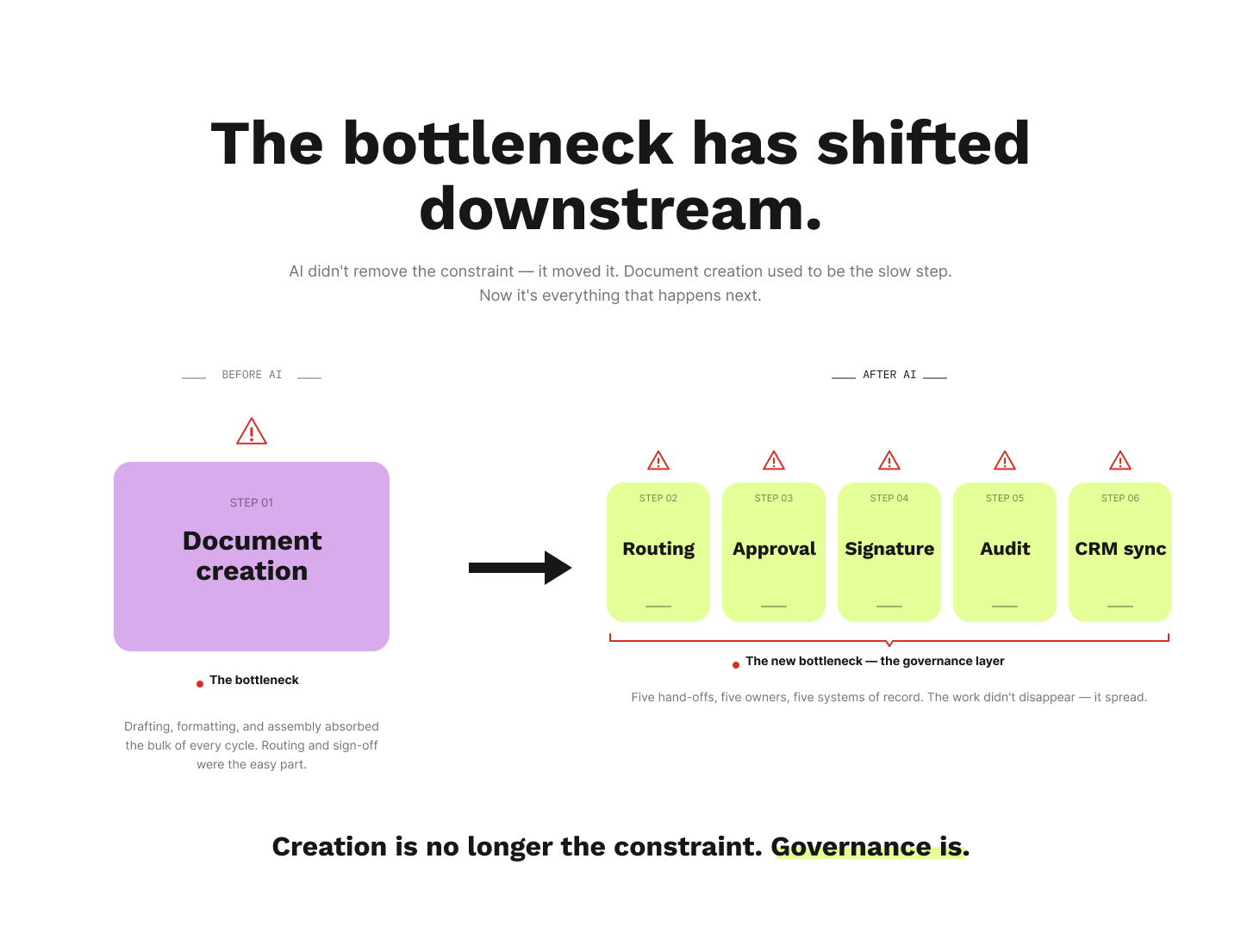
The bottleneck hasn’t disappeared. It has simply moved.
Organizations that once focused on accelerating document creation are increasingly being forced to focus on what happens after creation because that’s where delays, risk, and operational friction now accumulate.
What Document Governance Covers
Document governance has always been an essential part of the full document lifecycle, but AI acceleration has highlighted just how important it is.
The document governance layer covers everything after creation, including:
- Routing
- Approval
- Execution
- Auditing
- CRM write-back
A lack of automation in the governance layer exposes operations to failures and risks. When these steps are still done manually, delays occur, compliance risk goes up, costly mistakes happen, and operational efficiencies stall. Let’s look at each step in more detail:
Routing
Routing determines where a document goes next and who needs to take action. In many organizations, routing still relies on email, spreadsheets, shared drives, or internal knowledge. When documents are sent to the wrong stakeholder or fail to reach the right one at all, work stalls. Contracts sit unattended, approvals are delayed, and teams lose visibility into status.
Approval
Approval is often where document processes experience their longest delays. According to Ironclad, contracts can take an average of 35 days to execute. Documents move between managers, legal teams, finance stakeholders, and executives, with little visibility into where they are or who is holding them up. Without automated workflows, reminders, and escalation paths, approvals become inbox-driven processes that slow revenue, purchasing, hiring, and other critical business activities.
Execution
Once a document is approved, it still needs to be executed. Manual signature collection creates additional friction as teams chase signers, resend documents, and track completion status. Delays at this stage can postpone deal closure, project kickoff, vendor onboarding, and other time-sensitive business outcomes. Plus, chasing signatures can eat up thousands of hours per month that could otherwise be used on revenue-generating activities.
Auditing
Every business document creates a record of decisions, approvals, and commitments. When governance processes are manual, maintaining a complete audit trail becomes difficult. Missing documentation, inconsistent recordkeeping, and fragmented systems increase compliance risk and make audits more time-consuming and costly.
CRM Write-Back
A document often contains information that needs to be reflected elsewhere in the business. Contract values, renewal dates, pricing terms, customer commitments, and approval outcomes all need to be captured accurately in systems of record, such as Salesforce. When updates are entered manually, errors and omissions become inevitable and the Salesforce → Document → Salesforce loop never closes. The result is unreliable reporting, poor forecasting, and operational decisions based on incomplete data.
Individually, these issues may appear manageable. Collectively, they create a governance bottleneck that limits the organization’s ability to move documents from creation to business outcomes. AI didn’t create these problems, but did make them impossible to ignore.
As document volumes continue to increase, automating at the governance layer can cut contract cycle times by 40% and keep work moving forward.
*Using data from Ironclad’s 2026 Contracting Benchmark Report: https://ironcladapp.com/resources/reports/2026-contracting-benchmark-report
+Assuming a 40% reduction in cycle times
Good News for Operations Teams
For operations leaders, this governance gap is actually a good problem to have. Operations teams already own the governance layer and AI has exposed its vulnerabilities. You know how to solve this problem. It’s just a matter of positioning it correctly to get buy-in across the organization.
The governance layer sits at the intersection of process, systems, compliance, and business outcomes, which are all areas that operations teams like yours have traditionally managed. While business users focus on creating documents, operations teams understand what happens after creation: how documents move through workflows, where approvals get stuck, how data flows between systems, and where risk enters the process.
That perspective puts you in a unique position to lead the conversation. The challenge goes beyond faster document creation. Documents need to move efficiently from creation to approval, execution, reporting, and action.
Organizations looking to capture the full value of AI-driven productivity gains will need someone to address the growing gap between creation speed and operational throughput. As an operations leader, you’re already closest to the workflows, systems, and governance processes that determine whether work moves forward or gets stuck. Your operations team is the natural owner of the next phase of document transformation.
The AI Trap Teams Have Fallen Into
There’s a common pattern that’s been emerging in today’s document-driven organizations: leaders are investing heavily in AI drafting tools, drastically speeding up contract creation times to hours instead of days, and are celebrating those wins and using them as proof that AI investments pay off.
But here’s the thing, not enough leaders are focusing on the other side of the coin. Document creation changed, but routing, signature workflow, and CRM sync haven’t. So, as document volume goes up, the governance layer is getting more and more congested. It’s a trap created by rapid AI advancements.
Yes, AI is making us more efficient in some ways. And that’s an important distinction to make. If we are only using it on one part of a workflow, it’s not an efficiency gain. It’s a backlog generator.
There’s a governance labor cost that AI creation speed is making worse. Teams who are still relying on manual processes might spend 100+ hours a week on administrative tasks associated with document governance. But investing in automation across entire document workflows can cut that down to 20 hours a week.
Removing bottlenecks from document workflows doesn’t necessarily mean adding an extra tool to your technology stack. It might mean taking a look at your entire stack, seeing where the inefficiencies are, and looking for opportunities to consolidate your stack instead of adding to it.
The Financial Implications of Gaps in Document Governance
Leadership wouldn’t invest in only one area of a sales cycle, so that same mentality should apply to the document lifecycle. Gaps in document lifecycle governance affect budgets, and this is where leadership should be brought in.
Right now, team budgets are chasing AI for document creation. What they actually need is automation for entire document workflows. The line item shouldn’t be for a single puzzle piece, it should be for the complete set.
A document automation platform like altaFlow has a deep impact on document-driven organizations. altaFlow is a no-code solution that addresses the entire document workflow layer. It combines document generation, PDF editing, workflow automation, contract management, and eSignature in one governed platform and it automatically syncs data back to your CRM, successfully closing that document to Salesforce loop.
Customers running document workflows on altaFlow see:
- Contract cycle times reduced by 40%
- 100+ admin hours reduced to 20 to 30
- Automation build time cut by 80%
- Doubled ROI
- 5 separate document tools consolidated into 1 platform
You might be thinking, “Okay, but what is this going to cost me?” And actually, altaFlow costs 30% less than DocuSign, Conga, and PandaDoc. Ultimately, investing in document governance leads to cost savings, not extra costs.
When the real operational constraint is in governance, not in creation, it doesn’t make sense to dedicate your whole budget to tools that only solve for part of the equation. What you save in creation time you lose in delays, costly human errors, and licensing fees for up to 24 different tools.
Shifting Perspectives: What You Can Do Differently
You need buy-in for governance initiatives, and the most effective way to get that is to frame it as a cost and risk reduction opportunity.
Begin by mapping your document approval chain from end-to-end by counting:
- Manual handoffs
- Approval steps
- Signature requests
- Spreadsheet updates
- CRM entries
Estimate the average delay at each stage and multiply that by your monthly document volume. The result is a tangible measure of operational drag that leadership can understand.
Consider a 750-employee organization that processes 100 contracts and business documents each month. Conservatively, we’ll assume two errors for every 10 documents generated, so approximately 20 document errors a month. If each error requires two hours of rework at an average labor cost of $122 per hour, that’s $4,880 in direct rework costs each month.
But wait, there’s more. Now, add the time spent tracking down signatures. If employees spend just 10 hours per month chasing approvals and eSignatures, that’s another $1,220 per year in lost productivity for each person involved. Multiply that across multiple stakeholders, departments, and approval chains, and the cost rises quickly.
And these figures don’t account for delayed revenue, missed renewal opportunities, compliance exposure, or inaccurate CRM data. Governance inefficiencies create measurable financial costs. Once those costs are quantified, the business case for full document workflow automation becomes much easier to justify.
In Summary: What to Do About the New Document Bottleneck
Content creation has become faster, cheaper, and more accessible. But creating documents is only one part of the picture. Approval cycle times remain slow. Revenue is still delayed. Team members are still chasing down eSignatures and compliance risk is still growing.
Organizations are not seeing the full productivity gains promised by AI because they’re missing the governance layer.
If your organization is investing in AI for document creation but has not touched its approval routing logic in three years, you have not automated your workflow. You have accelerated your bottleneck.
Here’s your opportunity to make the right change. See how altaFlow governs the document lifecycle that AI acceleration makes more critical.